Multi-regime classification based on applicable jurisdictions (A2/ML/AMA/DU, EAR/CCL, ITAR/USML). For EAR: the De Minimis rule and the Foreign Direct Product Rule, applied automatically. Per-country license checks (EAR country groups) and sanctions screening — all in one tool, with an AI assistant that never cites a code it hasn't actually found in the database.
The export control classification tool that is the most complete and most effective on the market — designed to be used by a small business just as much as by the most recognised experts, including within the French authorities.
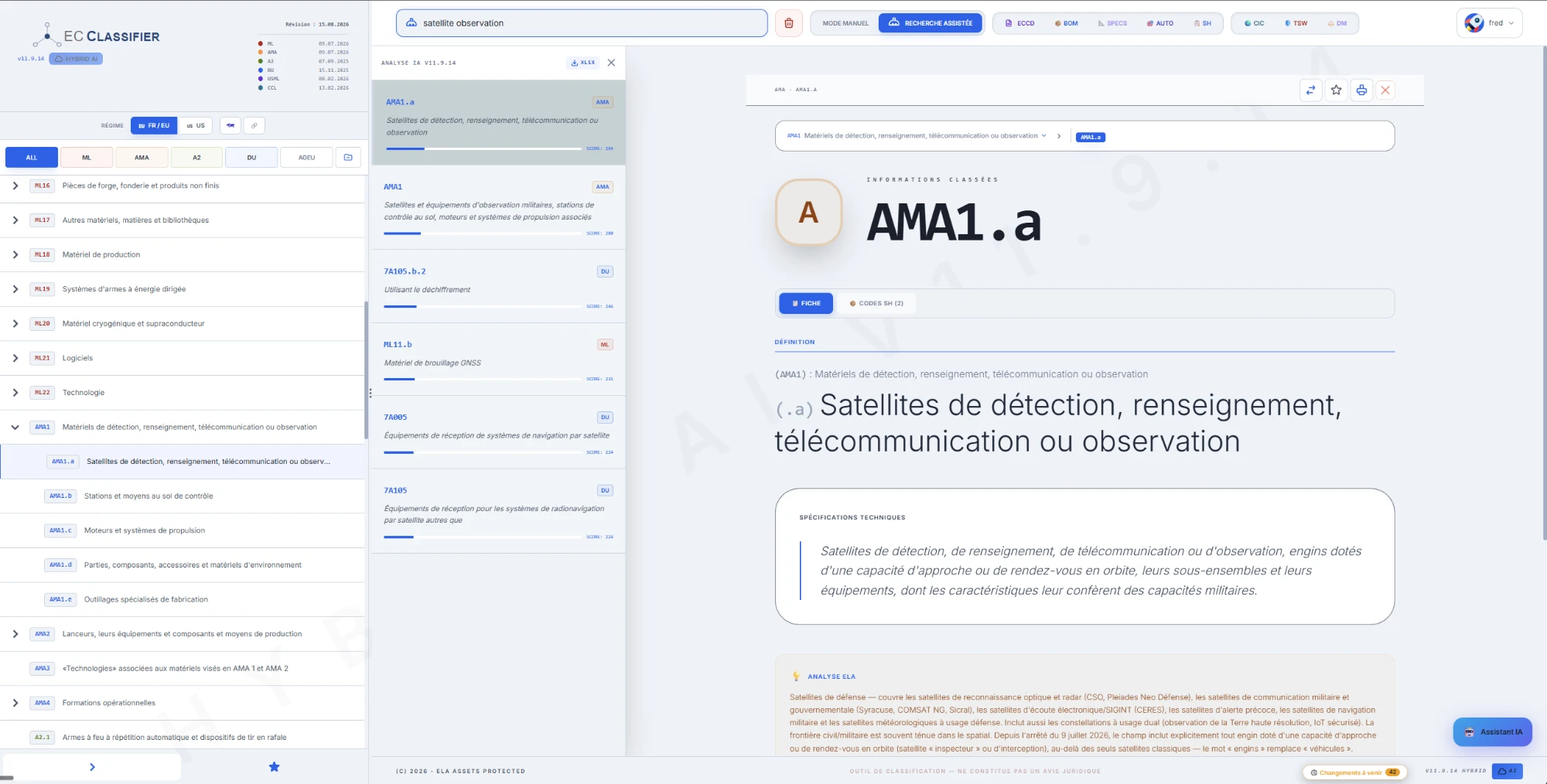
Don't trust a general-purpose AI to help you classify an export-controlled product. EC Classifier runs its own AI mechanism, with its own rules and its own data — benchmarked, calibrated and verified against current regulations, not picked up loosely across the internet.
Proprietary regulatory database — France/EU (A2, ML/AMA, DU), United States (EAR, ITAR), United Kingdom (UKML, UKDU) China (military list and dual-use list), India (SCOMET list) and the United Arab Emirates (military list and dual-use Schedule) — verified and corrected against official sources. Not a generic corpus, no approximations. For China, the Chinese text is authentic; the English version is an unofficial working translation.
Never cites a code outside of a search actually performed in the regulatory database. No free-form generation on top of results.
Never infers anything from information missing in the technical datasheet provided. It asks instead of assuming.
Follows the regulatory cascade logic (ML→AMA→DU, ITAR→EAR, UKML→UKDU, Chinese military list→dual-use list; most specific heading for India's SCOMET list, military list→dual-use Schedule for the Emirates) instead of examining regimes out of order. Every suggestion is traceable.
Search, BOM classification, screening, De Minimis and regulatory monitoring all run on our own database, with no third-party cloud involved. Only datasheet auto-classification and the assistant call an AI, from the provider of your choice — or your own AI, on request. Learn more
Your PDFs are read in your browser: text extraction and character recognition (OCR) of image pages happen on your own machine, and the file is sent to no server — neither a third party's nor ours. Only the relevant text is sent to the AI, and only when you launch an AI analysis; local search sends nothing. The application itself is hosted on a sovereign French server.
Many tools promise “AI”. With EC Classifier, you know what is doing the work, on which references, and where your information goes.
The tool works on its own database: regulations and classification codes optimized, verified against official sources and kept up to date. Not a general-purpose corpus learned from the Internet.
Search, code classification, BOM, licensing, screening, De Minimis, monitoring: everything runs within the tool, with no external AI. AI only comes into play when you call on it.
When you want AI, an integrated module builds on this reference data (datasheet auto-classification, assistant) — and the AI provider is your choice: several are supported.
For the most demanding organizations: on-premises deployment on request, with an AI hosted on your side or your own AI. Your technical datasheets stay within your infrastructure.
EC Classifier adapts to your needs across all its features — not a list of standalone options, a complete compliance chain.
A classification in minutes instead of hours of manual research across scattered regulatory texts.
An exportable justification file for every classification, citing the exact texts and sub-items relied on — ready to defend your decision in an audit, instead of reconstructing it after the fact.
Built-in regulatory monitoring: upcoming amendments are visible before they take effect, not discovered after the fact.
Classification, BOM, De Minimis, FDPR, licensing, screening and audit-ready reports in a single tool, instead of juggling multiple sources.
Each regime is treated in its own right, with its own text and its own thresholds: nothing is aligned from one regime to another. A selector switches between them in one click — search, tree, sheets, AI assistant, auto-classification and BOM follow the chosen regime.
Multi-regime AI search (A2/ML/AMA/DU, USML/CCL), backed by a proprietary database of synonyms and industry keywords to find the right classification in seconds, even without knowing the exact regulatory jargon. Understands military/civil/space context. Manual AND/OR search and HS code search also available.
Upload one or more technical datasheets for the same product (PDF, Word, text — FR/EN/DE/ES/IT): the AI assistant asks the missing questions and proposes up to 3 candidate codes with a confidence score, following the regulatory cascade (ML→AMA→DU, ITAR→EAR).
AI auto-classificationA structured 5-step questionnaire (product identification, technical specifications, classification analysis, results & reasoning, PDF generation) to produce an official export classification document, with detailed reasoning and a confidence score — exportable in French, English, or side-by-side bilingual.
Bilingual official documentExcel/CSV import of a complete Bill of Materials, automatic column mapping, assisted line-by-line classification, export of the result to Excel and PDF.
Bill of MaterialBuilt-in US content calculator (EAR §734.4): 10% or 25% threshold depending on item type, direct import of values/origins from a BOM, saved calculation history.
EAR §734.4Beyond De Minimis: the Foreign Direct Product Rule (FDPR, §734.9), ITAR-proscribed countries, EAR country groups — a single engine determines the jurisdiction applicable to a transaction.
FDPR · ITAR · EAR country groupsFor a given code and destination country: automatic cross-check against the Commerce Country Chart, license exceptions (EAR) and embargoes — instant verdict (no license required, license required, exceptions available, embargo).
Quick License CheckComplete country profile: regulatory status, control groups, license exceptions (EAR), active embargoes — viewable on screen or exported to PDF for a case file.
A 6-step screening assistant: Part 744 lists (Entity List, MEU...), OFAC (SDN, SSI, 50% rule), consolidated EU sanctions — risk verdict and recommended action.
The classification engine combines a proprietary regulatory database (A2/ML/AMA/DU/EAR/ITAR nomenclatures, industry synonyms, cascade rules) with an information model built and verified in-house — not a public LLM's general knowledge applied to a regulatory topic.
Classification document, code sheet, country card, screening report: exportable to PDF or Excel, in French, English, or side-by-side bilingual — everything needed for a complete file, ready for an audit or management review.
Organize your classifications into folders, pick up work already done without searching again, and share a sheet or an entire folder via a public link — accessible without an account, revocable at any time.
Facing several candidates, compare up to 7 codes side by side (definitions, automatically detected cross-references) to determine which one is really the right classification — then export the grid to Excel.
ECCN↔USML, ECCN↔EU ML, ML/AMA↔USML, DU↔Wassenaar correspondences and links to customs codes (HS), with a transferred-status indicator — to check that the same product stays consistent across regimes.
Texts already adopted but not yet in force are flagged directly on the relevant code's sheet — not just the current state of the regulation, but what's coming and when.
A regime in its own right, separate from FR/EU and US: the UK Military List (ML1 to ML22) and the Great Britain dual-use list, with their own text and thresholds (nothing is aligned with the EU); Northern Ireland-specific passages are flagged. Search, tree, sheets, AI assistant, auto-classification and BOM. Source: ECJU/DBT list of 16 December 2025, OGL v3.0 licence; legislation prevails where they differ.
UK Military List · UK dual-useA regime in its own right, with its two lists: the PRC MILITARY list (18 categories, published on 23 February 2026, replacing the 2002 list) and the Export Control List of Dual-Use Items (consolidated version of 31 December 2025, 189 codes), completed by MOFCOM announcements and the military products Regulation. Every sheet carries the Chinese text, which is authentic, and an unofficial English working translation; measures entering into force on 18 November 2026 (drones, tunnel boring machines, dredgers) are flagged “upcoming” on their sheet and on the list items they replace. The 2020 Law, Regulation 792 and the Blocking Rules can be consulted. Search, tree, sheets, AI assistant, auto-classification and BOM — and the tool never concludes that an item is “not controlled in China”: the catch-all clause and temporary controls exist outside the lists.
China · military list · dual-useA regime in its own right with a single list: the SCOMET list (Appendix 3 to ITC(HS), categories 0 to 8: nuclear, chemicals, micro-organisms, materials, aerospace, munitions, emerging technologies, dual-use), in the official English text of the DGFT, version of 23 September 2025, without translation: 550 entries, definitions and general notes. Search, tree, sheets, AI assistant, auto-classification and BOM. Sub-paragraphs stay in the text of each entry; the official list is authoritative and the tool never concludes “not controlled in India” merely because no entry applies.
India · SCOMET listA regime in its own right with two lists: the MILITARY list of the Ministry of Defence (ML1 to ML22) then the DUAL-USE Schedule annexed to Cabinet Resolution No. 156 of 2025 (EU/Wassenaar-type categories 0 to 9, plus category 10 — chemical weapons — and category 11 — national controlled commodities). English texts reproduced as published, older than the current EU lists: the AI never applies current EU thresholds. The military list (act no. 4 of 4 January 2022) is a scanned PDF: text recognised by OCR and checked against the Wassenaar and EU lists; it reproduces the Wassenaar Munitions List of 6 December 2018, without the December 2019 changes. Search, tree, sheets, AI assistant, auto-classification and BOM; never a “not controlled in the UAE” conclusion merely because no entry applies.
Emirates · military → dual-useSoftware, a technical file or a training course is classified according to the hardware it relates to: ML21/ML22, AMA, the D and E lines of dual-use. The tool asks which product or element it concerns when the document does not say and, for controlled data, helps tell a transfer from an export (storage location, external access, encryption), with a reminder of Annex IV and the catch-all clause.
IntangiblesFor any R&D study, any development or product cycle, in every field: the tool reads the document's TRL, asks for it when missing and applies the analysis grid — TRL 1 to 3 not controlled, TRL 4 grey zone to be confirmed by an analyst, TRL 5 to 9 controlled if the subject is. It is an analysis criterion, not a legal rule.
TRLA case replayed in the tool: a drone bill of materials, a thermal camera module, a shipment to the United Arab Emirates. Fictional data; real results from the tool, excerpts shortened.
Excel or CSV, hierarchy recognised by level.
An “existing classification” column is detected and each code is checked against the database.
Thermal imaging module — fictional datasheet.
Detector: uncooled VOx microbolometer focal plane array, 640 x 512 pixels
Spectral band: 7.5 to 13.5 µm (LWIR)
Frame rate: 30 Hz
No weapon sighting function. Not designed for any specific military use.
Corresponding EAR entry: CCL 6A003.b.4.b · country: United Arab Emirates (AE).
Classification register and PDF record (PV).
A layout built for small screens, not a shrunken desktop site: look up a code or ask the assistant on the move, at a customer's or in a meeting. Nothing to install: the application opens in your phone's browser.
Real screenshots of the application, on a 390 px screen.
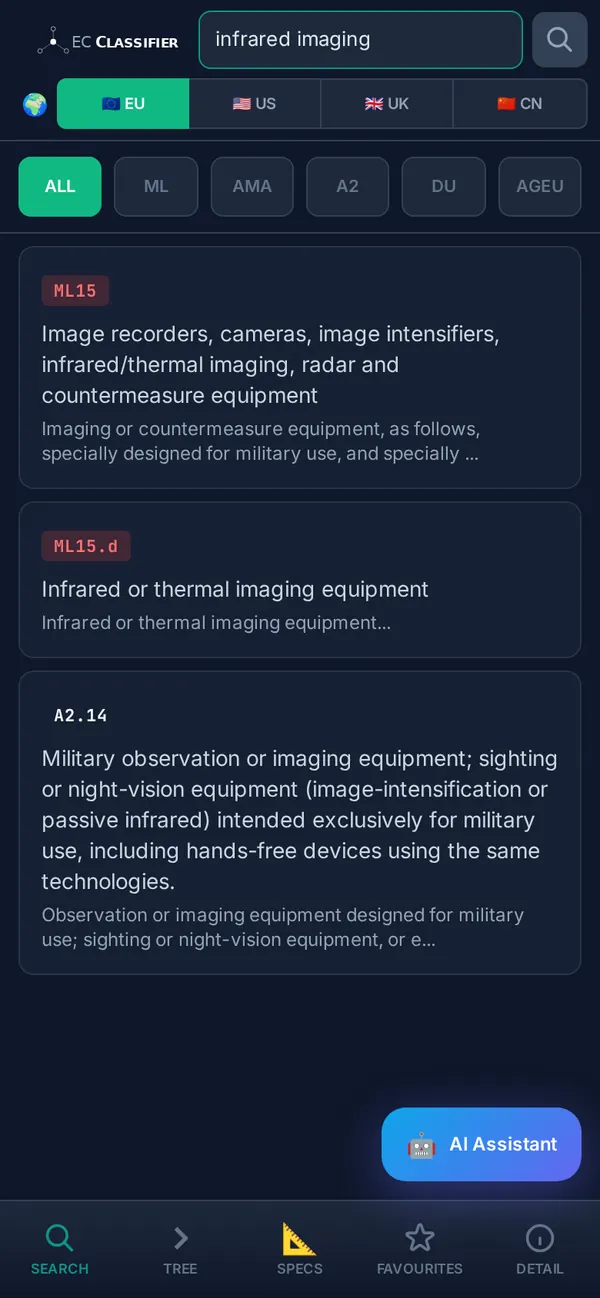
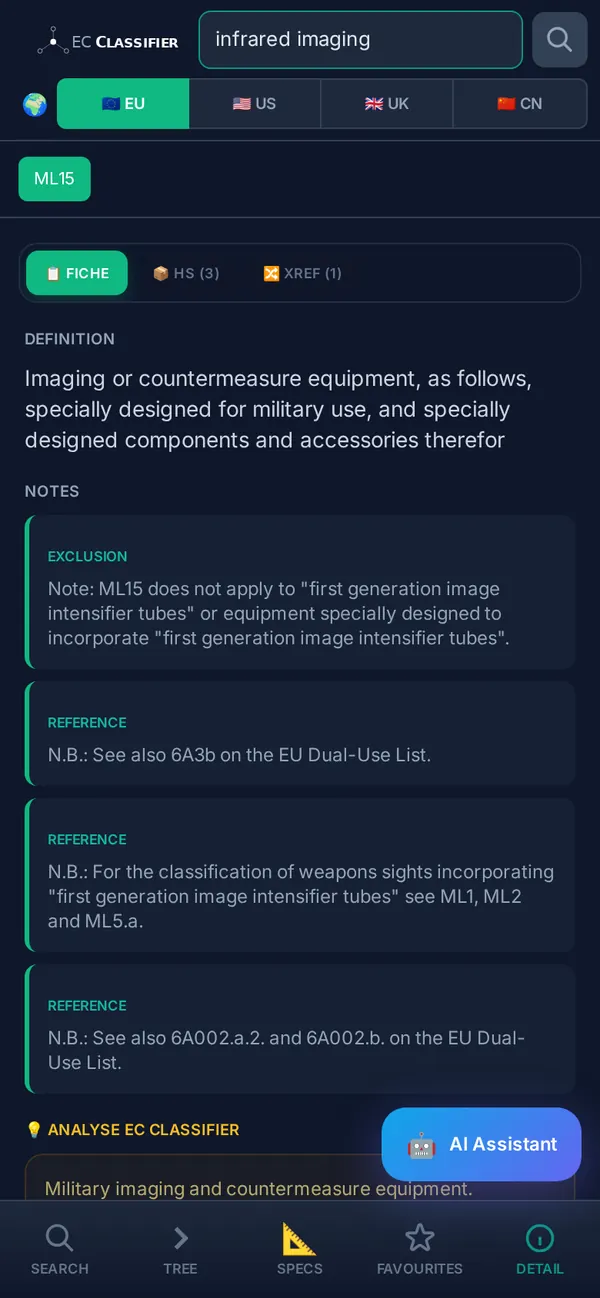
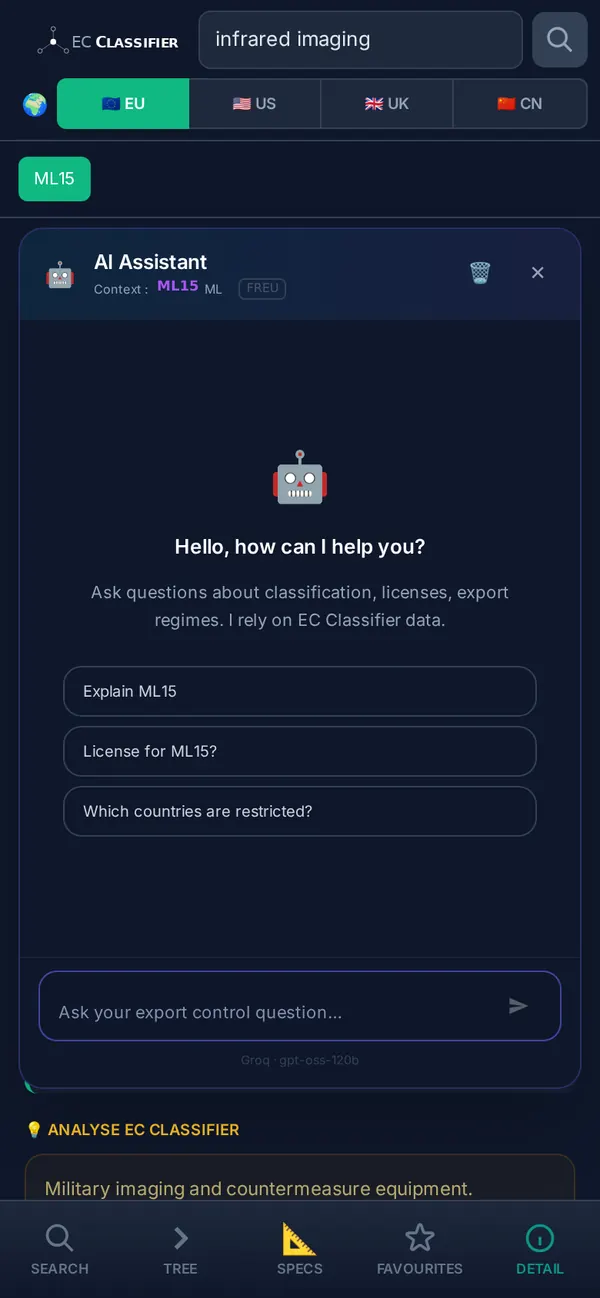
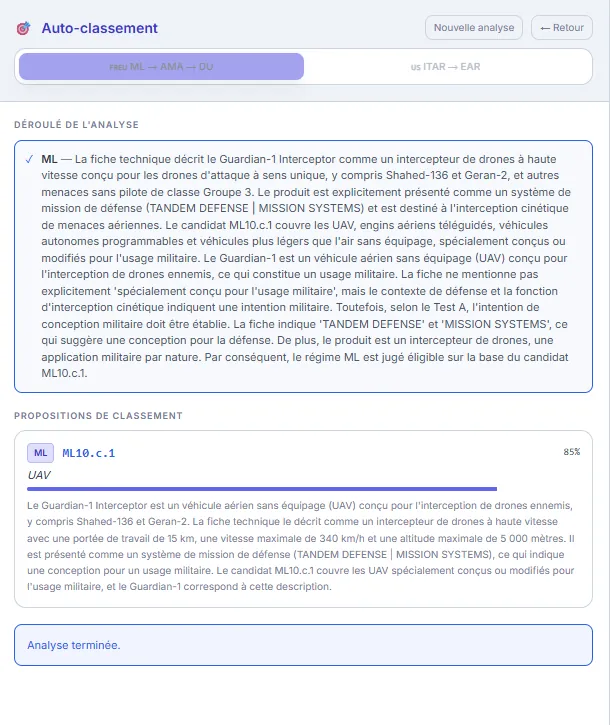
From an uploaded technical datasheet, the assistant details why each candidate is relevant, with a confidence score — never an answer out of nowhere.
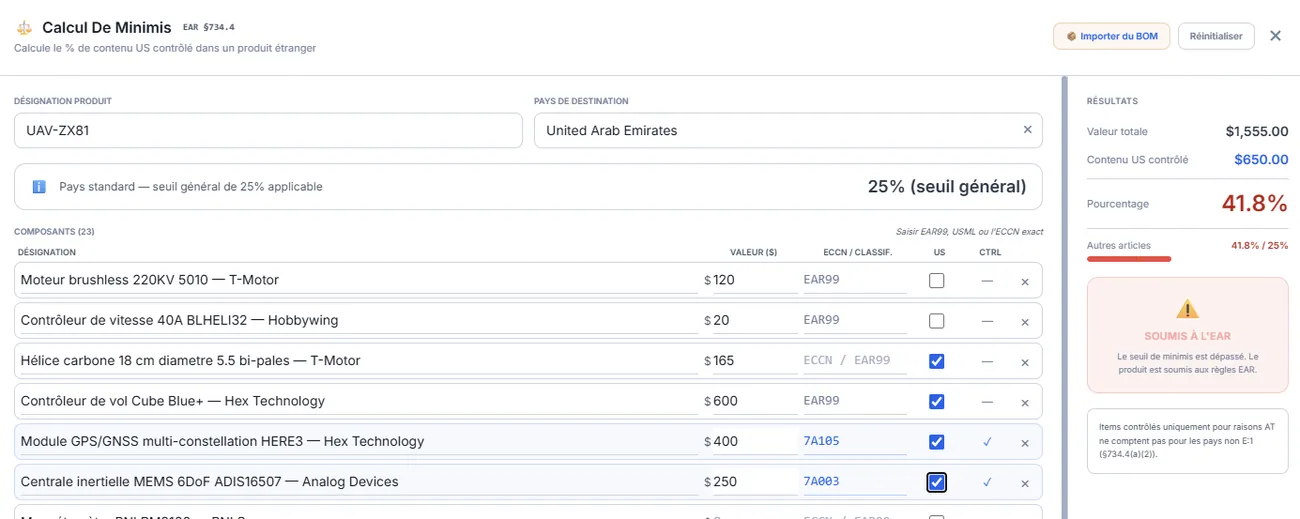
Import values from a BOM or enter them manually: the applicable threshold (EAR §734.4) adjusts based on destination, and the verdict updates in real time.
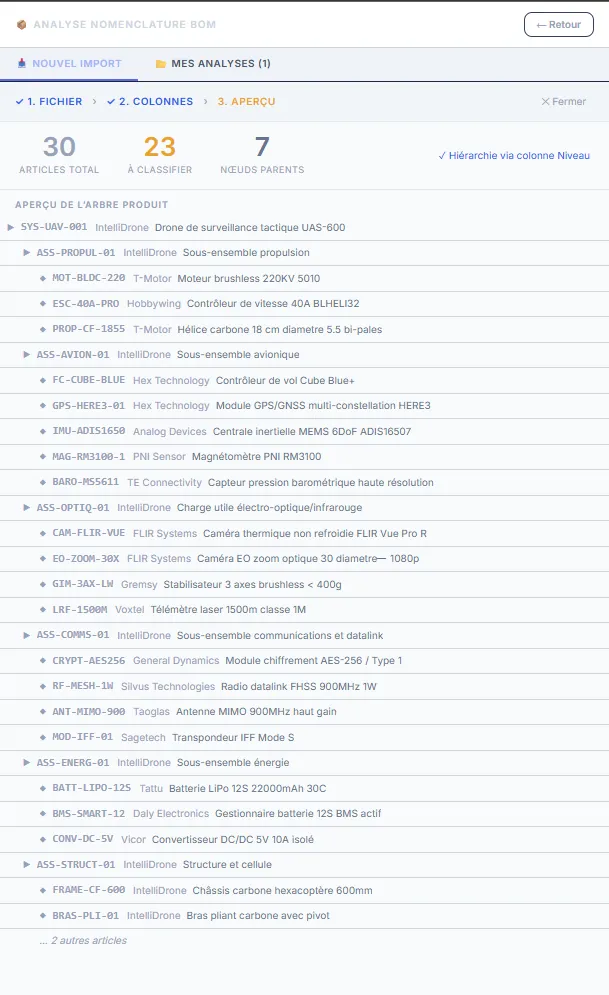
The complete tree of sub-assemblies and components, with manufacturers and designations — built for volume, not a one-off search.
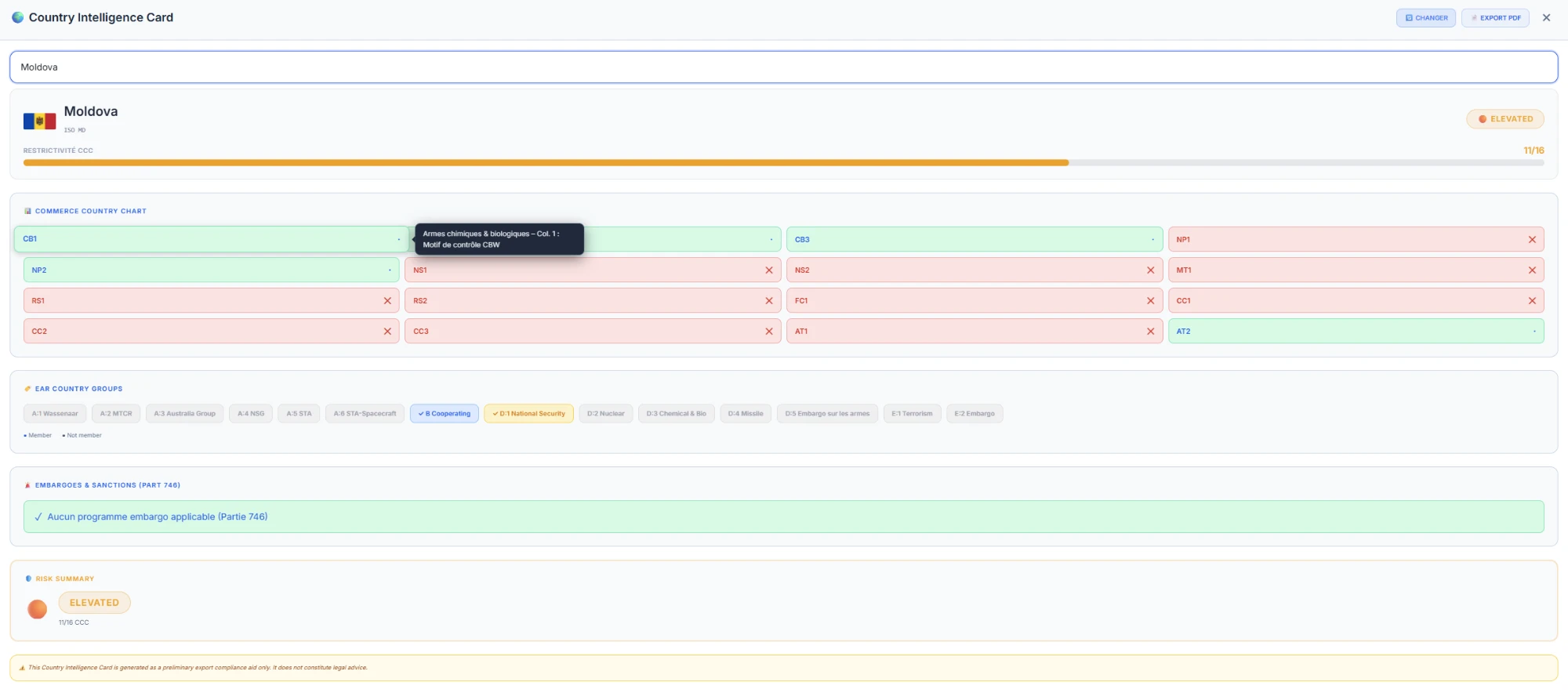
Commerce Country Chart, EAR country groups, active embargoes — for a given country, without juggling multiple sources.
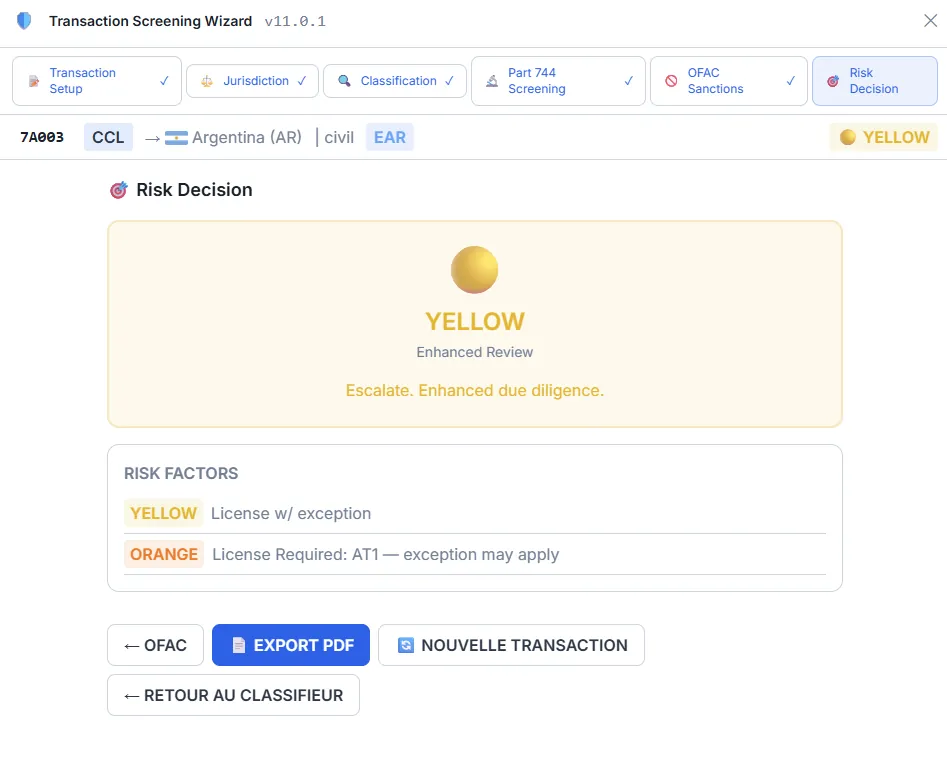
At the end of the 6-step screening process: a color-coded verdict and the recommended action that goes with it — proceed, enhanced review, license required, or block.
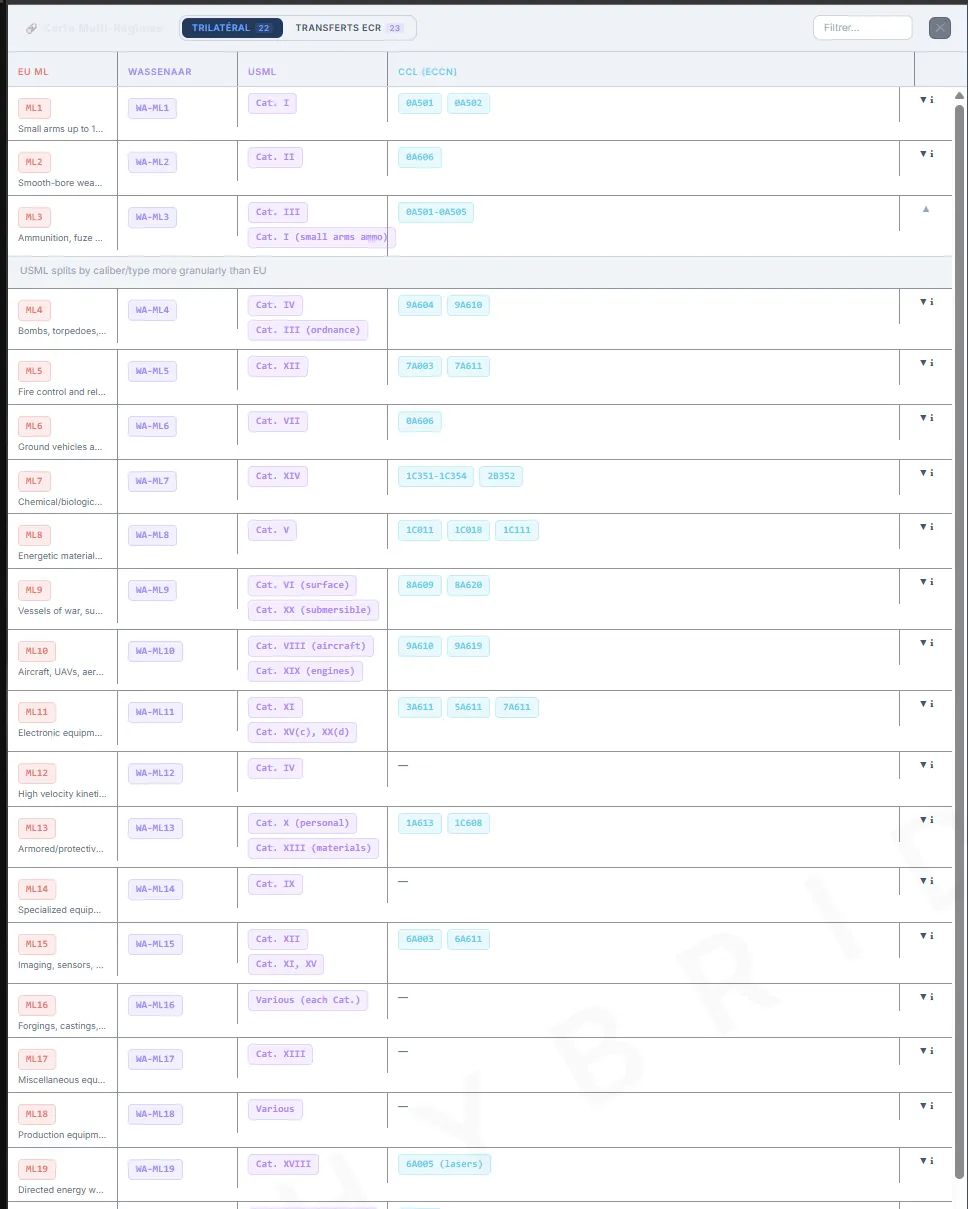
EU ML, Wassenaar, USML, CCL (ECCN): the complete correspondence table, in trilateral view or by ECR transfers — to find a code's equivalent in another regime without re-running a search.
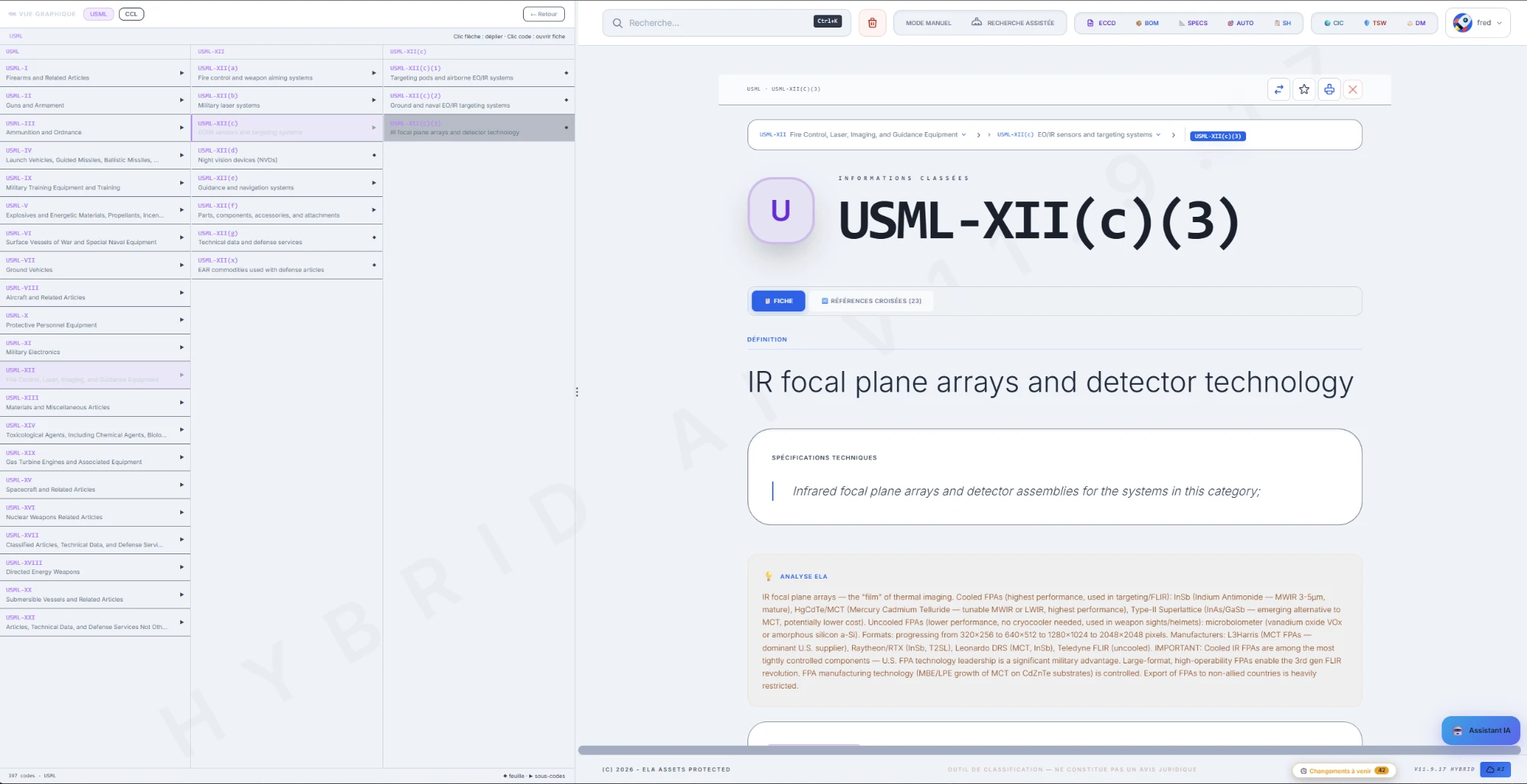
Browse a regime's categories and sub-categories column by column down to the code you're looking for, with the full sheet alongside — no guessing where the right entry is hiding.
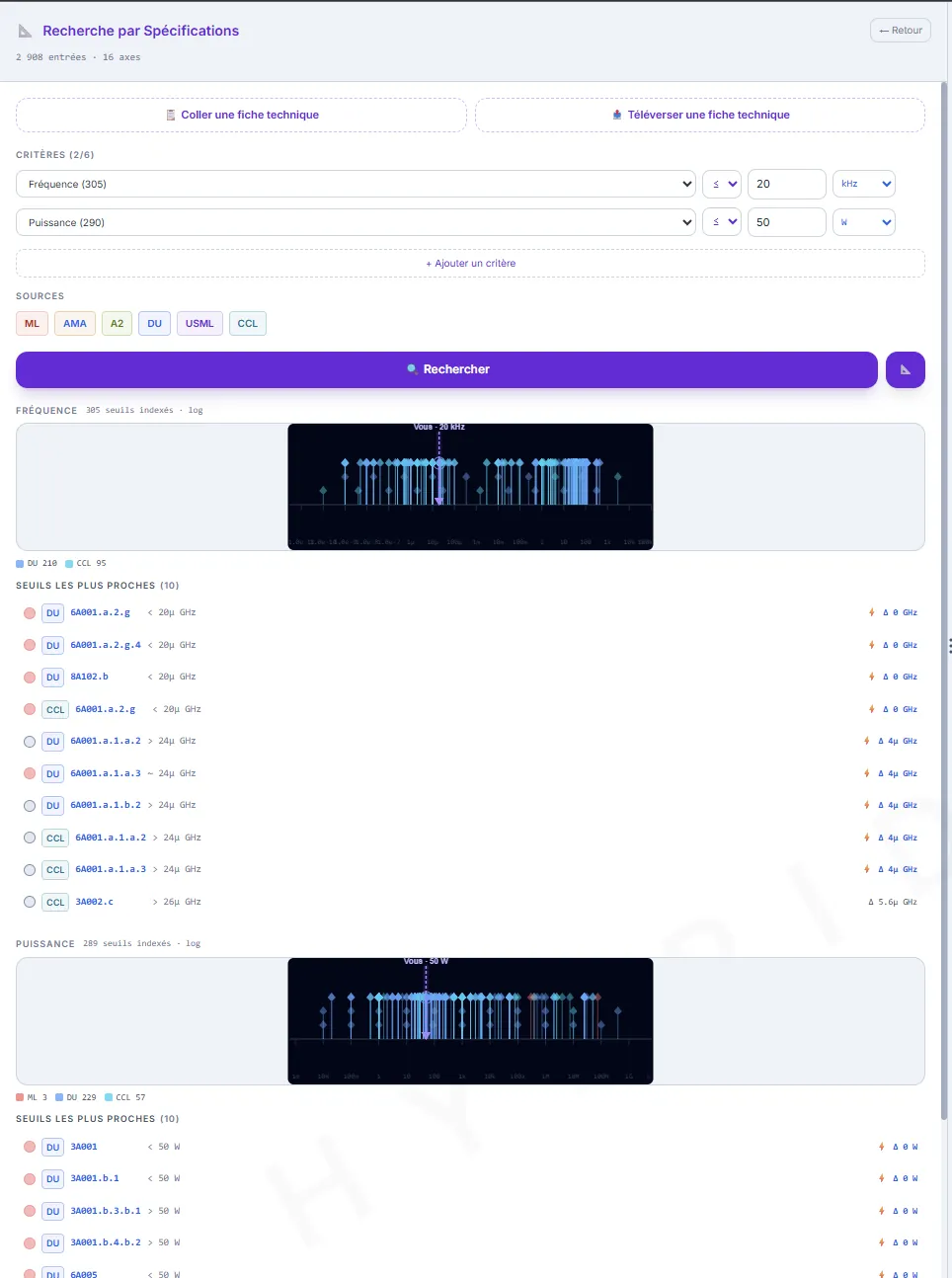
Frequency, power, and up to 6 simultaneous numeric criteria: paste or upload a datasheet, and find the closest regulatory thresholds across all regimes.
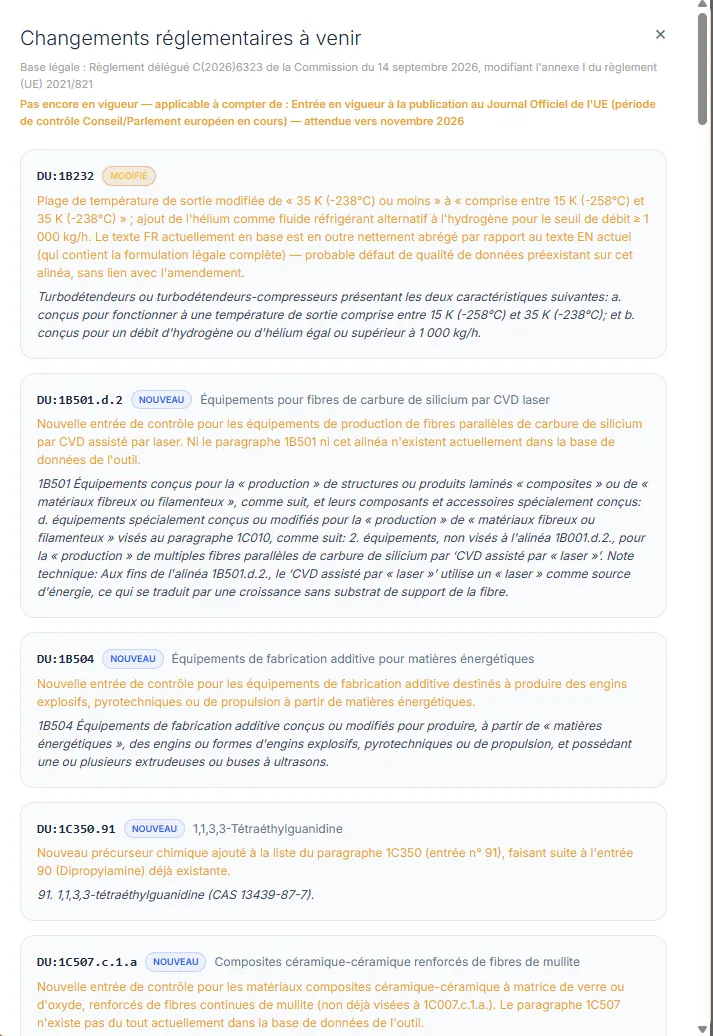
Legal basis, effective date, and the exact impact on each affected sub-item — to anticipate an amendment before it applies, not discover it after the fact.
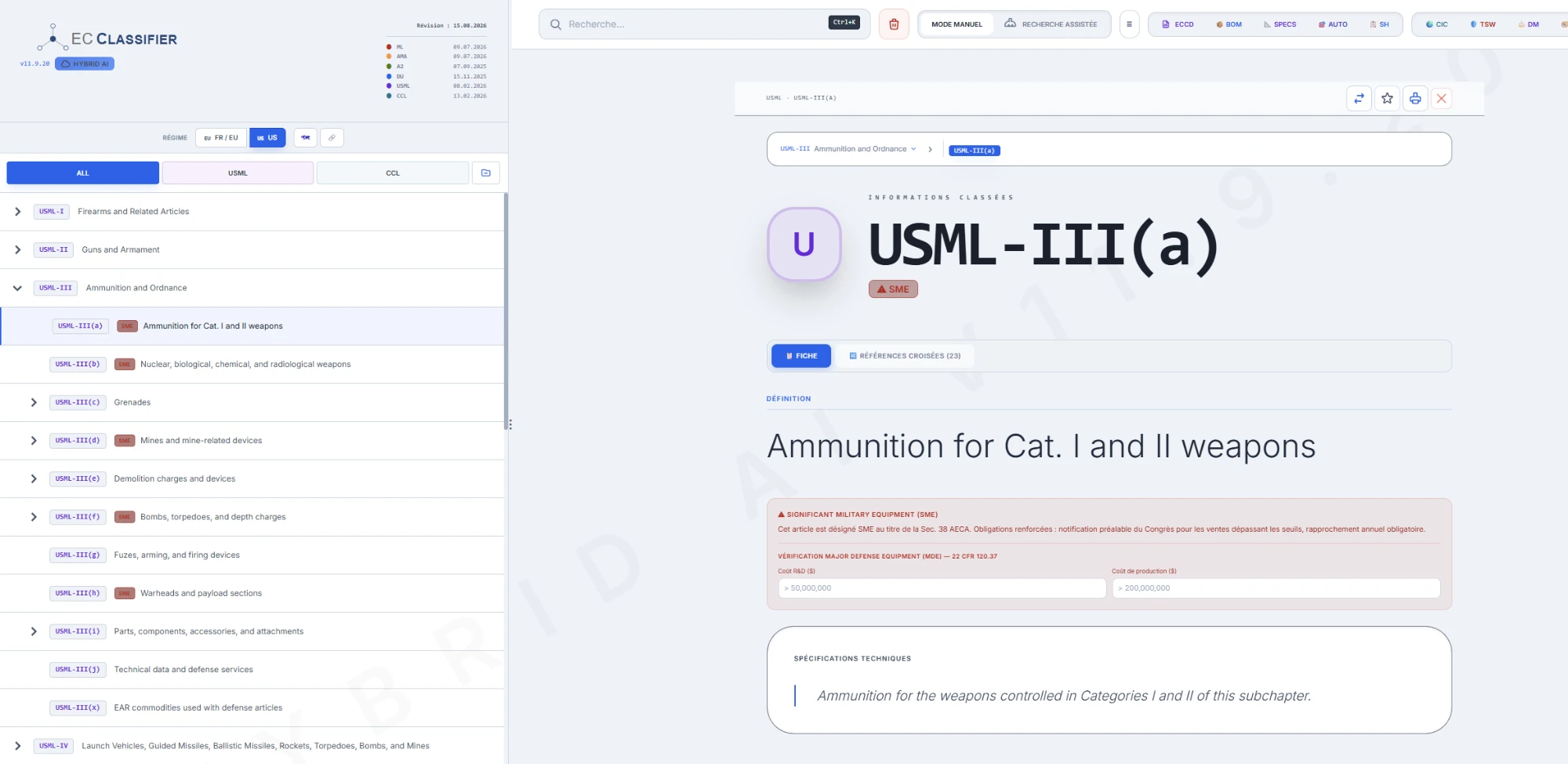
An SME code doesn't tell the whole story: enter the program's R&D or production cost, and the tool applies the regulatory threshold (22 CFR 120.37) to qualify — or not — as Major Defense Equipment.
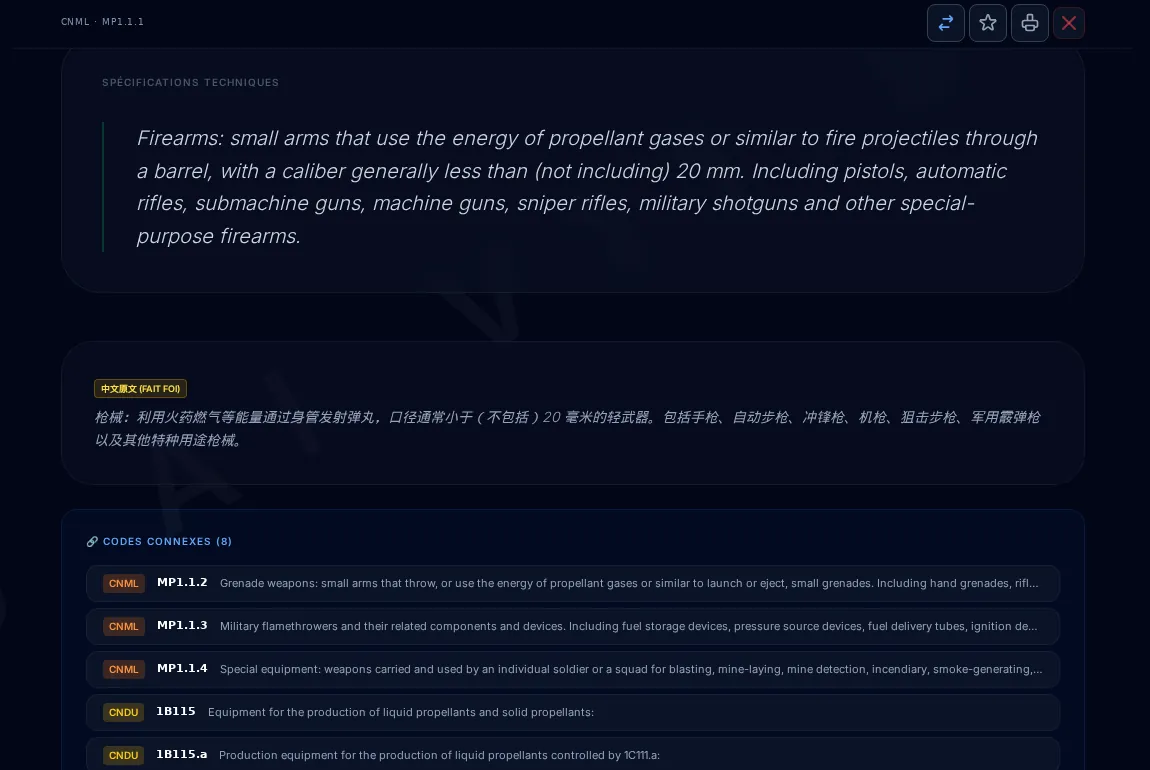
The 18 categories of the military list (published on 23 February 2026), then the dual-use list: every sheet carries the Chinese text, which is authentic, next to the English working translation, and only links to codes of the Chinese regime.
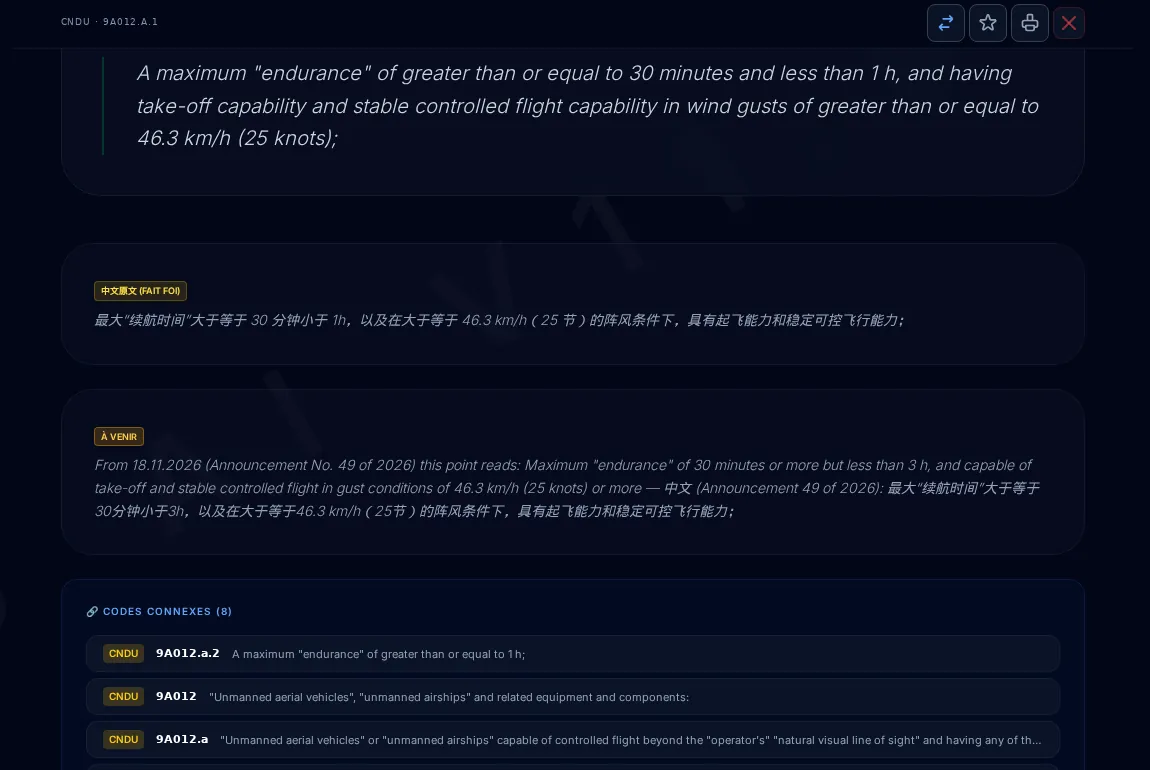
When a MOFCOM announcement replaces a point of the list, the sheet keeps the text in force and shows the new wording — working translation and Chinese original — with its date of entry into force.
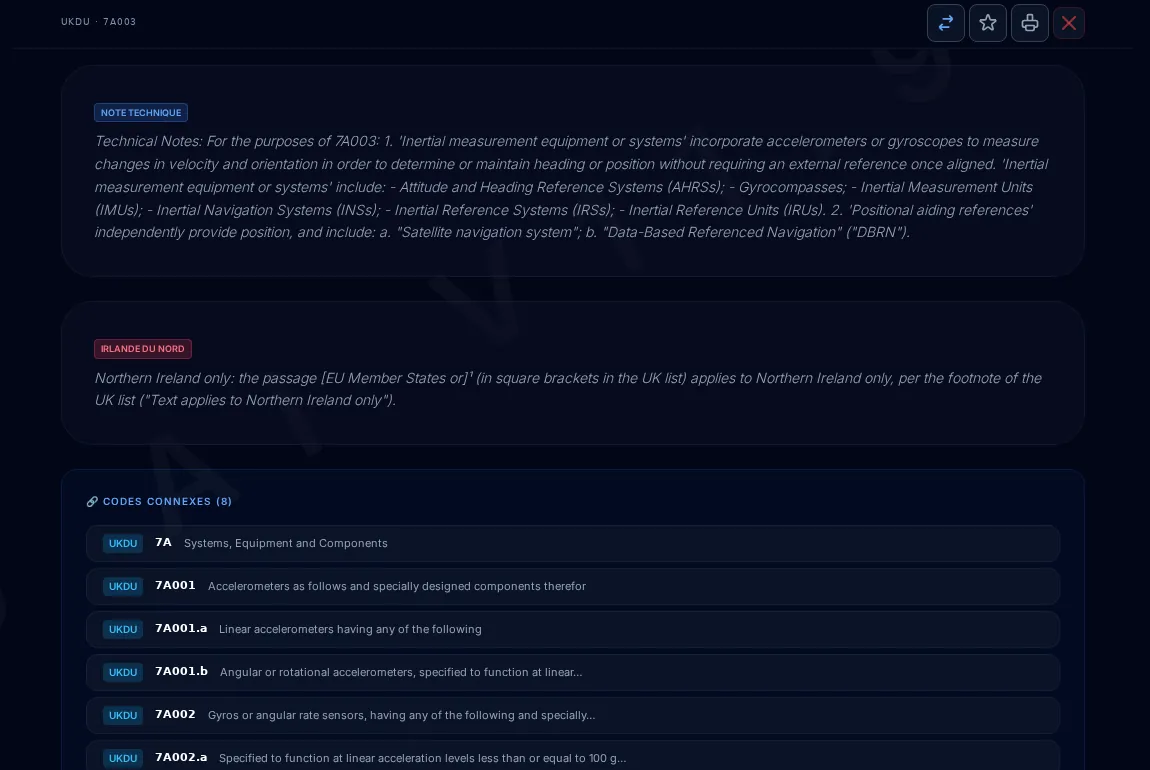
UK Military List and Great Britain dual-use list, with their own text: Northern Ireland-specific passages are flagged on the sheet, and related codes stay within the British regime.
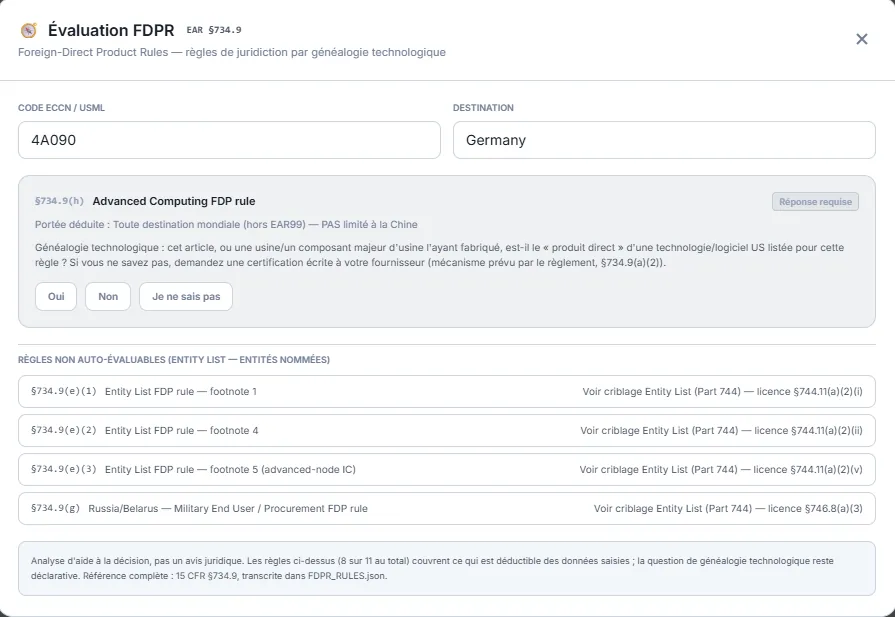
Code and destination are enough to flag the §734.9 rules that may apply — then the tool asks the one question it can't guess on its own: technology lineage, with a reminder of the supplier-certification mechanism required by the regulation.
Designed by ELA's export control experts, for everyone who touches the regulation — EC Officers, Engineering, Supply Chain, Legal, Management — not just specialists. A small business classifying its first product gets step-by-step guidance; the most recognised experts, including within the French authorities, get the exact text, the traceability and the depth they need.
Direct access to the application, or a demo with the ELA team on a real case.
Tell us about your needs — we'll get back to you shortly.
